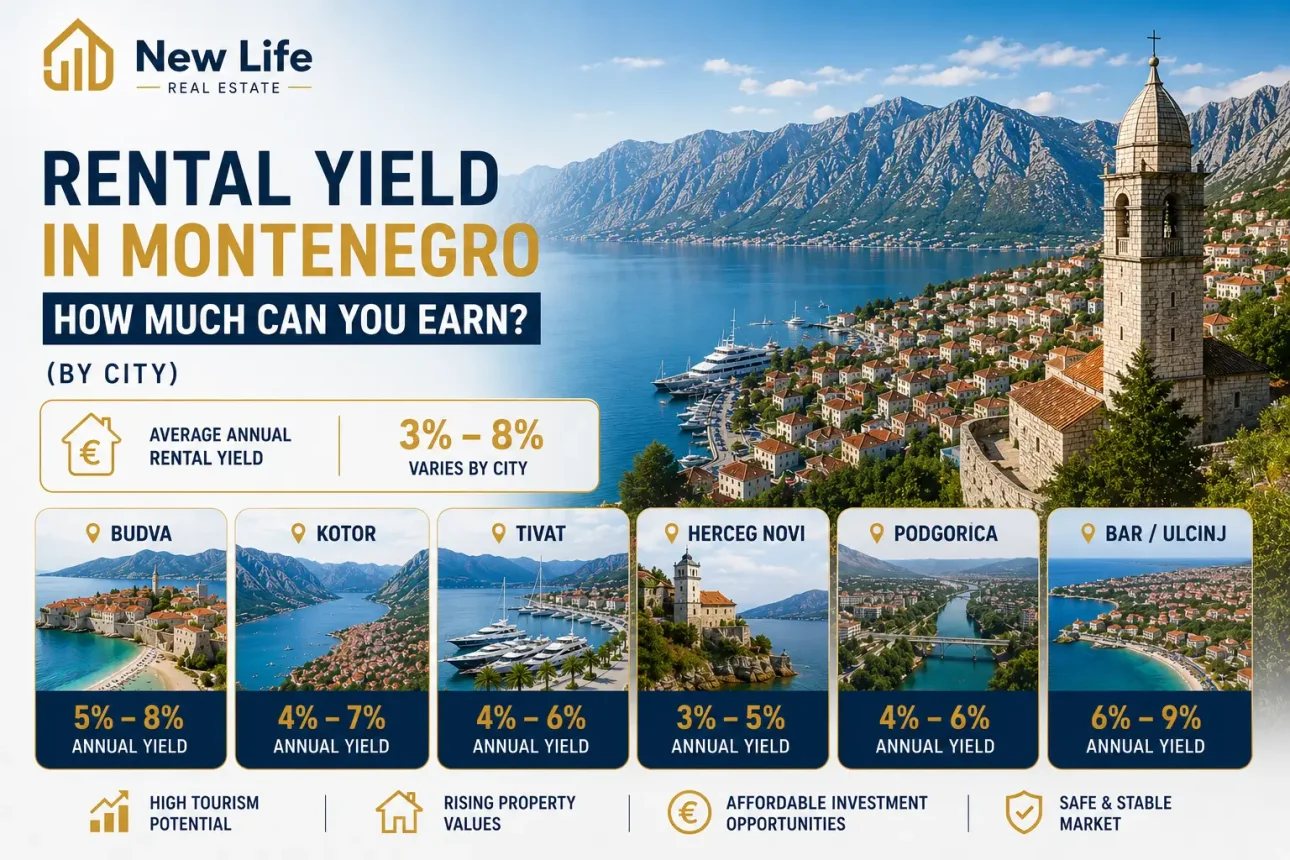


One of the top concerns for those looking to invest in real estate in Montenegro is rental yield. In particular, the opportunity to generate euro-denominated income and the potential for tourism-driven rentals make this country an attractive option for investors. However, when it comes to rental yields in Montenegro, the most important thing to know is this: Not every city offers the same returns.
While it is possible to generate high-season income through short-term rentals in some regions, in other cities, a more stable yet lower-risk long-term rental model takes precedence. Therefore, the potential return on investment can vary significantly depending on the chosen city, property type, location, and rental strategy.
While the short-term rental model stands out in tourist areas like Budva, Kotor, and Tivat, cities like Podgorica offer more consistent and long-term rental income. This creates a significant choice for investors between “the highest rent” and “the most stable rent.”
In this article, we will compare Montenegro’s cities in terms of rental returns, examine in detail which regions offer higher potential, and discuss what to consider when making an investment. If you’re looking for a clear answer to the question, “Which city in Montenegro yields the highest returns?” this content will provide you with a realistic roadmap.
What Is the Average Rental Yield in Montenegro?
Rental yields in Montenegro vary depending on the city where the investment is made and the leasing model used. However, looking at the overall picture, real estate investments across the country still offer a notable yield potential compared to many regions in Europe.
For long-term rentals, the average annual rental yield typically ranges between 4% and 6%. In this model, income is more stable, and operational costs are lower since the property is occupied by the same tenant for an extended period. This system is particularly common in cities preferred by working professionals, students, and those planning long-term stays.
In short-term rentals, however, the potential is higher. Especially in regions with heavy tourist traffic during the summer season, higher income can be generated through daily or weekly rental models. A property in the right location can achieve high occupancy rates throughout the season and significantly increase the annual total return. However, it should not be forgotten that in this model, expenses and the management process are just as important as income.
The most critical point to consider here is the difference between gross rental income and net rental income. Many investment listings emphasize only the high rental income. However, the actual profit emerges only after deducting maintenance fees, repairs, taxes, cleaning costs, platform commissions, and periods of vacancy. Therefore, to understand how much the investment truly yields, one must look not just at the rental figure but at the net ROI.
While some cities in Montenegro offer high rental potential, certain regions provide a more balanced and secure investment model. To better understand this distinction, we will compare short-term and long-term rental models in the next section.
Which Is More Profitable: Short-Term or Long-Term?
One of the most critical decision points regarding rental returns in Montenegro is how the property will be rented out. This is because the same property can generate completely different income levels depending on the rental model used. Therefore, the choice between short-term and long-term rentals is one of the key factors determining the actual profitability of the investment.
The short-term rental model primarily involves daily or weekly rentals through platforms like Airbnb and similar services. This system is quite common in Montenegro’s tourist cities. Especially during the summer season, daily rental prices rise significantly in areas like Budva, Kotor, and Tivat due to increased tourist traffic. Even a small apartment in the right location can generate high income throughout the season.
However, short-term rental does not simply equate to high income. This model also requires more operational effort. Cleaning, guest communication, check-in and check-out organization, price updates, and listing management must be regularly monitored. Additionally, off-season periods with vacancies must be factored in. Therefore, high gross income does not always translate to high net profit.
Long-term rentals, on the other hand, offer a different structure. In this model, the property is rented to the same tenant on a monthly or annual basis. The income level is generally lower than with short-term rentals, but the income becomes more stable and predictable. Furthermore, the operational process is much simpler, and management costs are lower.
The long-term rental model is particularly strong in cities like Podgorica, which have a high concentration of working professionals and students. In these areas, finding a steady tenant may be easier, and the investment can be managed with lower risk.
Ultimately, determining which model is more profitable is not a question with a single, definitive answer. While short-term rentals may be more advantageous for investors aiming for higher income, long-term rentals may be a more sensible option for those seeking a more stable and low-risk structure.
In the next section, we will examine city-specific rental yields in detail to determine which regions are more suitable for which investment model.
Rental Yield in Budva
Budva is one of the first cities that come to mind when discussing rental yields in Montenegro. As one of the country’s most densely touristed regions, it possesses significant potential, particularly for the short-term rental model. The increased number of tourists during the summer season drives up daily rental rates and pushes occupancy rates to substantial levels.
For this reason, many investors in Budva prefer to rent out their properties through platforms like Airbnb and similar services for short-term stays. Studio and 1+1 apartments located in central areas within walking distance of the sea are among the most sought-after options for investment. The fact that smaller apartments can be rented out more quickly can positively impact the investment’s payback period.
However, the high rental potential in Budva comes at a cost: purchase prices. Due to the high demand in the city, real estate prices exceed the Montenegro average. Therefore, evaluating an investment based solely on rental income can be misleading. True profitability becomes evident only when the purchase price is considered alongside the net rental income generated.
While it is possible to generate high income through the short-term rental model in Budva, this system requires professional management. In particular, failure to price correctly during the season, weak listing management, or poor customer experience can lead to a lower-than-expected occupancy rate. This directly impacts net returns.
Long-term rental is also an option in Budva; however, since the city has a tourism-focused structure, investors typically prefer the short-term model. For this reason, Budva stands out as a more suitable city for investors seeking high rental potential but willing to handle greater operational demands and competition.
In the next section, we will examine the rental yield potential in Kotor, which has a different investment structure.
Rental Yield in Kotor
Kotor is considered one of Montenegro’s most unique regions. Thanks to its historical character, natural landscape, and the old town center protected by UNESCO, it attracts tourists year-round. This makes Kotor a very strong city in terms of rental yield. However, unlike Budva, the primary advantage of investing here is not just high-season revenue but also the potential for long-term value preservation.
The short-term rental model is quite common in Kotor. Apartments located near the old town center or with sea views are particularly popular among tourists. During the summer season, daily rental rates rise significantly, and occupancy rates can reach high levels. This creates a strong income potential for investors.
However, purchase costs are also high in Kotor. Limited development in the region and the preservation of the historic fabric reduce supply while keeping demand high. Consequently, properties here are generally considered more valuable. Therefore, even though rental income may be high, the investment’s payback period can vary depending on the location and purchase price.
One of Kotor’s greatest advantages is that its tourist appeal has a more sustainable structure. The city continues to attract visitors not just during the summer season but throughout most of the year. This ensures a certain level of rental potential even during off-season periods.
On the other hand, there are certain points to consider when investing in Kotor. Maintenance costs may be higher for older buildings located in historic areas. Additionally, factors such as vehicle access, parking, and the convenience of daily life can also affect rental performance. Therefore, it is essential to proceed not merely based on the perception of a “tourist city,” but through detailed analysis.
Overall, Kotor stands out as a strong option for investors targeting long-term value appreciation alongside high rental potential. It offers an attractive urban structure, particularly for those seeking a more balanced and prestigious investment in the premium segment.
In the next section, we will examine the rental yield potential in Tivat, which stands out for its marina and luxury residential projects.
Rental Yield in Tivat
Tivat has emerged as one of the fastest-appreciating regions in Montenegro’s real estate market in recent years. The luxury residential projects developing around the marina and the lifestyle catering to high-income groups set the city’s rental market apart from other regions.
The rental income potential in Tivat is largely built on the premium segment. Thanks to marina projects like Porto Montenegro, the region attracts high-budget tourists and long-term foreign tenants. This situation ensures that rental rates, particularly for modern and luxury apartments, exceed the Montenegrin average.
From a short-term rental perspective, Tivat is one of the cities with high potential for nightly rates. Apartments around the marina, in particular, can generate strong income during the summer season. However, a key point to note here is that while rental income is high, purchase costs are also quite high. Therefore, even though rental figures in Tivat may seem impressive, the total investment cost must be carefully evaluated when calculating ROI.
The long-term rental model is also strong in Tivat. Thanks to foreign workers living in the area, marina staff, and high-income tenants who prefer long-term stays, a more stable rental structure can be established. This situation also offers an advantage for investors aiming for year-round income rather than just seasonal revenue.
Another key advantage of Tivat is its potential for value retention. Luxury projects in the city and international interest support the long-term strength of local real estate. Therefore, Tivat is an attractive option not only for rental income but also for those seeking a prestigious and long-term investment.
However, this city may not be suitable for every investor. This is because entry costs are higher compared to other cities in Montenegro. Consequently, Tivat stands out more for those seeking a safer and higher-quality investment in the premium segment rather than for investors with lower budgets.
In the next section, we will examine the rental income potential in Podgorica, which features a more stable structure focused on long-term rentals.
Rental Yield in Podgorica
As the capital of Montenegro, Podgorica has a different rental structure compared to other coastal cities. While short-term, tourism-focused rentals dominate in regions like Budva, Kotor, or Tivat, the long-term rental model is preferred in Podgorica. This makes the city attractive to investors seeking more stable and predictable income.
The tenant profile in the city generally consists of working professionals, students, government employees, and foreigners planning to live there long-term. Consequently, monthly and annual rental models are more common than daily or weekly rentals. This structure reduces the impact of seasonal fluctuations and ensures a more consistent rental income throughout the year.
One of the biggest advantages in Podgorica is that purchase prices are more balanced compared to coastal cities. While the same budget might only secure a small studio apartment in Budva or Tivat, it may be possible to purchase a larger and more modern apartment in Podgorica. This situation can positively impact the return on investment by lowering the initial cost.
In terms of rental yield, Podgorica does not offer the high income potential found in short-term rentals. However, it creates a safer investment model thanks to low vacancy risk and a more stable tenant base. This can be particularly advantageous for investors seeking steady income who prefer not to deal extensively with operational processes.
Additionally, the city’s universities, business centers, and government institutions keep the demand for long-term rentals consistently strong. This creates a rental structure that is less affected by market fluctuations.
Podgorica is one of the standout cities for investors seeking sustainable and balanced rental income rather than high-season profits. It can be considered one of the most sensible options in Montenegro for those seeking a lower-risk and more stable investment model.
In the next section, we will examine the rental potential in cities like Bar and Herceg Novi, which stand out in terms of value for money.
Rental Potential in Bar and Herceg Novi
While Bar and Herceg Novi are not typically as prominent as Budva or Tivat in terms of rental returns in Montenegro, they offer attractive options for investors seeking a balance between price and performance. These cities can present significant opportunities, particularly for those looking to enter the market with a lower budget.
Bar stands out for its quieter atmosphere and transportation advantages. As a port city, it maintains a certain level of activity year-round. Compared to coastal cities, more affordable real estate prices allow investors to acquire a larger or newer property within the same budget. This can help optimize investment costs and create a more balanced structure in terms of rental returns.
Short-term rentals are possible in Bar, though one shouldn’t expect the same level of tourist activity as in Budva. In contrast, a more stable structure can be observed for long-term rentals. Especially for foreigners who prefer local life and long-term tenants, Bar offers a quieter alternative.
Herceg Novi, located on Montenegro’s northern coast, is a region particularly notable for its natural beauty. While the city attracts tourists during the summer months, it also appeals to foreigners seeking a quieter lifestyle. Consequently, its rental market offers a balanced structure suitable for both short-term and medium-to-long-term rentals.
One of the biggest advantages in these regions is that purchase prices are lower compared to more popular tourist cities. This situation can create an advantage in terms of ROI, especially for those investing with a limited budget. Thanks to the lower entry cost, the payback period for the investment can become more balanced in some cases.
However, when investing in these cities, expectations must be set realistically. Seasonal income as high as that in Budva or Tivat may not always be achievable. Nevertheless, lower competition, more affordable properties, and long-term development potential make Bar and Herceg Novi attractive alternatives.
Overall, these regions offer a structure better suited for those seeking balanced growth and more accessible investment opportunities rather than aggressive returns.
In the next section, we will examine the factors that directly increase rental yields in Montenegro and discuss which details influence investment performance.
Factors That Increase Rental Yield
In Montenegro, rental yield is not solely dependent on the choice of city. Even two similar properties located in the same city can generate completely different income levels due to certain details. Therefore, one of the most important factors determining how much an investment will actually yield is how well the property is located.
Location is the most important factor in increasing rental yield. Properties located within walking distance of the sea, near tourist centers, and in areas with easy access are rented out more quickly. This situation both increases occupancy rates and makes it possible to set higher rental prices.
The physical condition of the property also directly impacts rental performance. Apartments with modern designs, fully furnished, and move-in ready are particularly preferred for short-term rentals. Today, tourists and foreign tenants value not only location but also the living experience. Therefore, a small but well-decorated apartment can generate higher income than a larger but older property.
In the short-term rental model, professional management makes a significant difference. Processes such as the use of high-quality photos, listing optimization, price updates, and guest communication can significantly impact occupancy rates. Especially on platforms like Airbnb, well-managed properties with high ratings can be rented out at higher rates.
Seasonal management is also a key factor. While the summer season is very strong in some regions of Montenegro, demand may drop during off-peak periods. Therefore, investors must focus not only on the potential income during the summer months but also on the overall annual occupancy rate.
Additionally, the purchase price indirectly affects rental yield. A property purchased at a lower price than another with the same rental income naturally provides a higher ROI. Therefore, one must look not just at the rental figure but at the return generated relative to the property’s cost.
Finally, the region’s development potential can also influence long-term rental performance. New infrastructure projects, marina investments, or increased tourism activity can lead to rising rental rates in certain areas over time.
When all these factors are considered together, achieving high rental returns in Montenegro is not merely a matter of “buying a good property,” but rather requires acting with the right analysis and strategy.
In the next section, we will examine the most common mistakes investors make that reduce rental yield and discuss which errors negatively impact ROI.
Mistakes That Reduce Rental Yield
When investing in real estate in Montenegro, aiming for high rental yields is a natural expectation. However, many investors fail to achieve the performance they expect due to certain fundamental mistakes. Even details that may seem minor—especially for those without prior experience in overseas investments—can significantly impact rental income.
One of the most common mistakes is purchasing a property solely because it is low-priced. Some homes that appear affordable may be located in areas with low demand. This situation can lead to the property remaining vacant for an extended period or being rented out at low rental rates. Consequently, the investment’s payback period lengthens, and ROI decreases.
Another major mistake is failing to analyze the location thoroughly. Even within the same city, some areas may see high demand from tourists or tenants, while others may have very limited demand. Especially when planning for short-term rentals, walkability, proximity to the beach, and access to social amenities are of great importance.
Underestimating the operational process in the short-term rental model is also a common problem. To generate high income on platforms like Airbnb, professional photos, proper pricing, and strong customer communication are essential. Poor management of these processes can lower occupancy rates and reduce visibility due to negative reviews.
Another common mistake is focusing solely on gross rental income. Many investors assume the investment is highly profitable upon seeing high rental figures. However, when factoring in maintenance fees, upkeep, cleaning costs, platform commissions, taxes, and periods of vacancy, net income can drop significantly. Therefore, it is essential to always examine net returns to understand the true performance.
Underestimating purchase costs is also a major factor that negatively impacts ROI. If title deed fees, notary fees, furniture, renovations, and management expenses are overlooked, the total cost of the investment may be underestimated. This leads to unrealistic return expectations.
Additionally, making an investment solely with the intention of short-term gains is risky. In developing markets like Montenegro, the true potential of certain areas often becomes apparent over time. Therefore, acting with patience and a well-thought-out plan usually yields healthier results.
In summary, the primary factor reducing rental returns in Montenegro is usually not the market itself, but rather incorrect strategy and insufficient analysis. When the right decisions are made, however, it is possible to achieve much stronger results in the same market.
In the next section, we will examine which city is more suitable for which investor profile and discuss how to make more informed decisions when selecting a city
Which City Makes More Sense for Whom?
There is no single “best city” in Montenegro in terms of rental yield. This is because every investor’s goal is different, and each city offers a distinct investment model. Therefore, the right city selection should be evaluated based on how well it aligns with the investor’s expectations.
For investors targeting high rental income and strong seasonal earnings, Budva is often one of the top choices. The city offers strong potential, particularly for investors working with a short-term rental model. However, due to high competition and high purchase costs, Budva is better suited for those seeking to make more active and hands-on investments.
Kotor, on the other hand, appeals to those seeking a more premium and balanced investment. Thanks to its historic character and limited supply, it has strong long-term value preservation potential. This city may be a more sensible choice not only for rental income but also for those seeking a prestigious and long-term investment.
Tivat stands out for those targeting the luxury segment. Projects around the marina offer premium rental potential as they cater to a high-income tourist and foreign tenant profile. However, due to high entry costs, it is suitable for investors with larger budgets.
For investors seeking a more stable and low-risk rental model, Podgorica may be a more sensible option. It is easier to find long-term tenants in the city, and the income structure is more predictable. Podgorica offers a more manageable investment model, particularly for those who do not wish to deal with ongoing operations.
Bar and Herceg Novi, on the other hand, are attractive alternatives for investors seeking a balance between price and performance. These regions can offer advantages for those looking to enter the market with lower initial costs. Additionally, their long-term development potential could present a significant investment opportunity.
In conclusion, when selecting a city, one should focus not merely on the question “which location yields the highest returns?” but rather on “which investment model suits me best?” Because the right city is not the one offering the highest rent; it is the one that aligns most closely with the investor’s goals.
In the next section, we will clarify the financial aspects of the investment by addressing what a realistic ROI expectation for rental income in Montenegro should be.
What Should a Realistic ROI Expectation Be in Montenegro?
Many people considering real estate investment in Montenegro may expect to make significant profits in a very short time due to stories of high rental yields. However, to create a realistic investment plan, it is essential to have balanced and accurate expectations regarding ROI.
Generally, in Montenegro’s long-term rental model, the net ROI rate typically ranges between 4% and 6% annually. This rate may vary depending on the city, purchase price, rental levels, and operating expenses. This range is considered quite reasonable, especially for investors targeting more stable income.
In the short-term rental model, the potential is higher. In well-managed properties in tourist areas, the annual return can be higher. However, an important point to note here is that high apparent income does not always translate to high net profit. This is because in short-term rentals:
- platform commissions
- cleaning costs
- management costs
- off-season vacancies
- maintenance costs
directly impact net returns.
Therefore, making an investment decision based solely on high nightly rates is not prudent. What truly matters is how much the investment actually yields after all expenses are deducted.
Additionally, when evaluating ROI, not only rental income but also long-term value appreciation should be taken into account. In emerging markets like Montenegro, the appreciation of property value over time can increase the total return on investment. This is particularly evident in investments made in the right locations.
For a realistic approach, it is more accurate to view real estate investment in Montenegro not as a “get-rich-quick” scheme, but as an investment that can provide foreign currency-based income and long-term growth. This market can offer strong opportunities for patient and strategic investors.
In the next and final section, we will provide a clear overall assessment of rental returns in Montenegro by bringing together all cities and investment models.
Which City in Montenegro Offers the Highest Returns?
When considering rental yields in Montenegro, it is evident that each city offers a distinct investment model. Therefore, the city yielding the highest returns may vary depending on the investor’s objectives.
While Budva and Kotor stand out for their high-season revenue and short-term rental potential, Tivat offers a more premium and high-budget investment model. In contrast, Podgorica establishes a more stable structure focused on long-term rentals. Cities like Bar and Herceg Novi, meanwhile, attract those seeking a balanced investment opportunity with lower entry costs.
The key point here is not to focus solely on the highest rental income; rather, it is to evaluate the true ROI by considering the purchase cost, expenses, and management process together. This is because while rental rates may be high in some cities, the purchase cost may be equally high. This, in turn, affects the investment’s payback period.
In conclusion, rental income in Montenegro still offers strong investment potential. However, for a successful investment:
- the right city
- the right location
- the right leasing model
- the right price level
must be evaluated together.
When making an investment decision, focusing on the question “Which investment model is better suited for me?” rather than just “Where will I make more money?” leads to much healthier results.
If you’re looking to evaluate investment opportunities in Montenegro that offer high rental yields and fit your budget, we can analyze the best city and property options for you together.
Let’s Identify the Right Investment for You in Montenegro
If you want to make a high-yield rental investment in Montenegro, choosing the right city and the right property can completely transform the entire process. By analyzing options that align with your budget, your targeted rental model, and your investment expectations, we can create the most logical investment plan for you.
To view customized, up-to-date portfolios, compare rental potentials by city, and receive realistic ROI calculations, please contact the Newlife Guide team.




 +382 69 980 968